Ethiopia's exporters sold almost four times as much coffee to China last season as they did two years earlier. Uganda still had more than a million farms to map. With Europe's deforestation rules applying from 30 December, the region's coffee is dividing into lots that can prove where they came from and lots that cannot, and most of it flows through the same hands.
Ninety days out
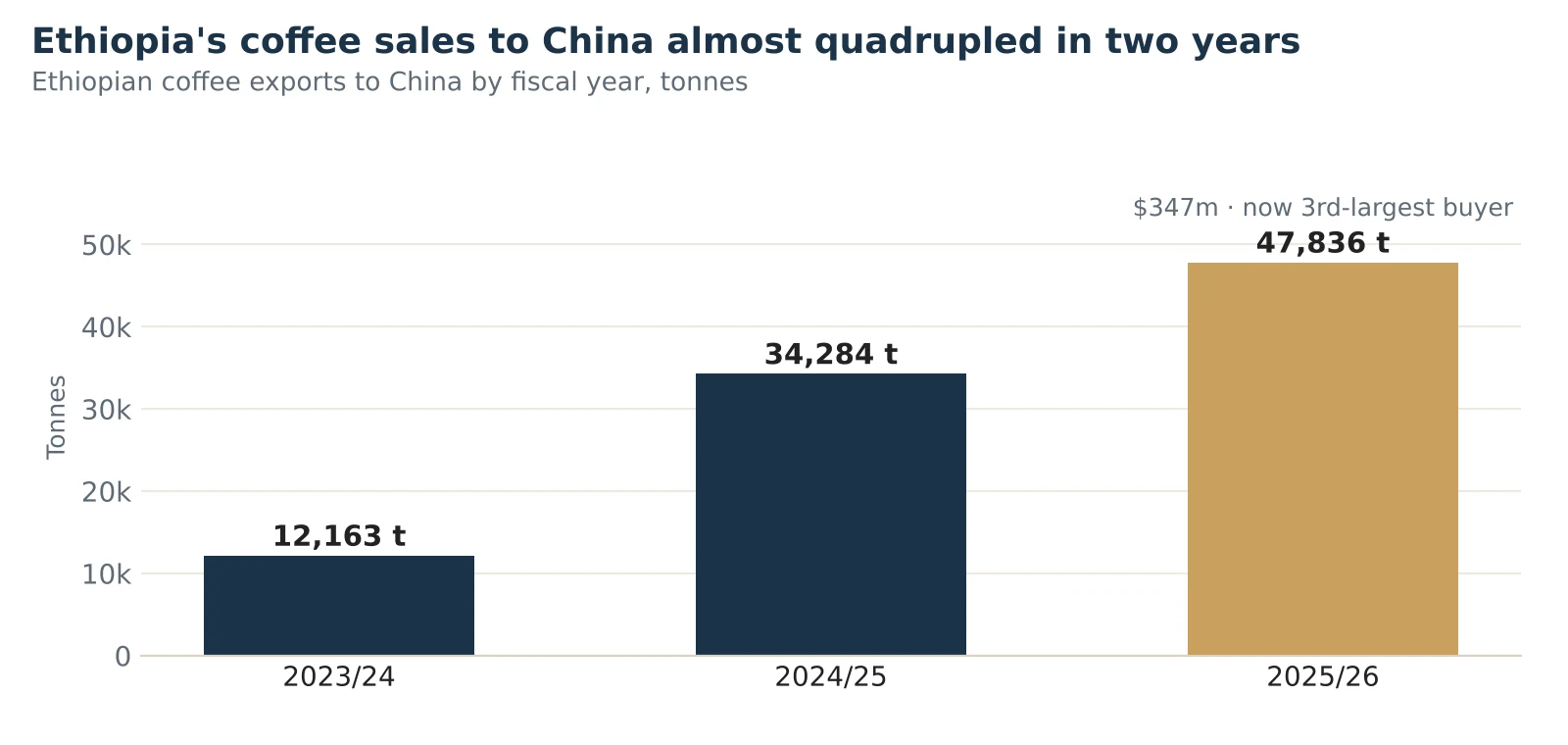
On 27 September, Ethiopia's Capital newspaper reported that the country's exporters had shipped 47,836 tonnes of coffee to China in the 2025/26 fiscal year, worth $347 million. Two years earlier the figure was 12,163 tonnes. China is now Ethiopia's third-largest buyer, behind Saudi Arabia and Germany, in a year when total coffee exports reached a record of about $3 billion.
Exporters are open about one of the reasons. Europe takes around 30% of Ethiopia's coffee, and from 30 December 2026 the large and medium companies that place coffee on the EU market must hold the coordinates of the plots where it was grown and proof that the land was not deforested after 2020. Ethiopia has more than five million smallholder coffee farmers. Its national traceability system, with GPS mapping and mobile collection tools, has been handed over, and the industry itself calls implementation a significant challenge.
Uganda, the other large East African exporter, is in a similar position. At a coffee roundtable in Uganda in mid-September, attended by two of the world's largest green coffee traders, the figures on the table were 1.6 million farms mapped out of an estimated 2.8 million. About 80% of Uganda's coffee comes from smallholders on plots of under two hectares, many without formal land documents. Europe takes 62% of Uganda's exports.
A market with two doors
The regulation was written to stop deforestation, and East African coffee is a relatively low-risk crop on that measure. Much of Ethiopia's coffee grows under shade trees in forest or semi-forest systems. The European Commission rates Uganda as a standard-risk country, not a high-risk one. Many in the industry argue, with some justice, that smallholders are being penalised for paperwork rather than for clearing forest.
The effect on the market is already visible. Coffee that can be mapped and documented goes to Europe, where it earns access to the largest buyers. Coffee that cannot goes elsewhere: China, the Gulf, North Africa, and domestic markets. Neither door is illegal. Saudi Arabia, the UAE and China do not apply the EU's rules, and a roaster in Riyadh buying unmapped Ethiopian coffee is doing nothing wrong.
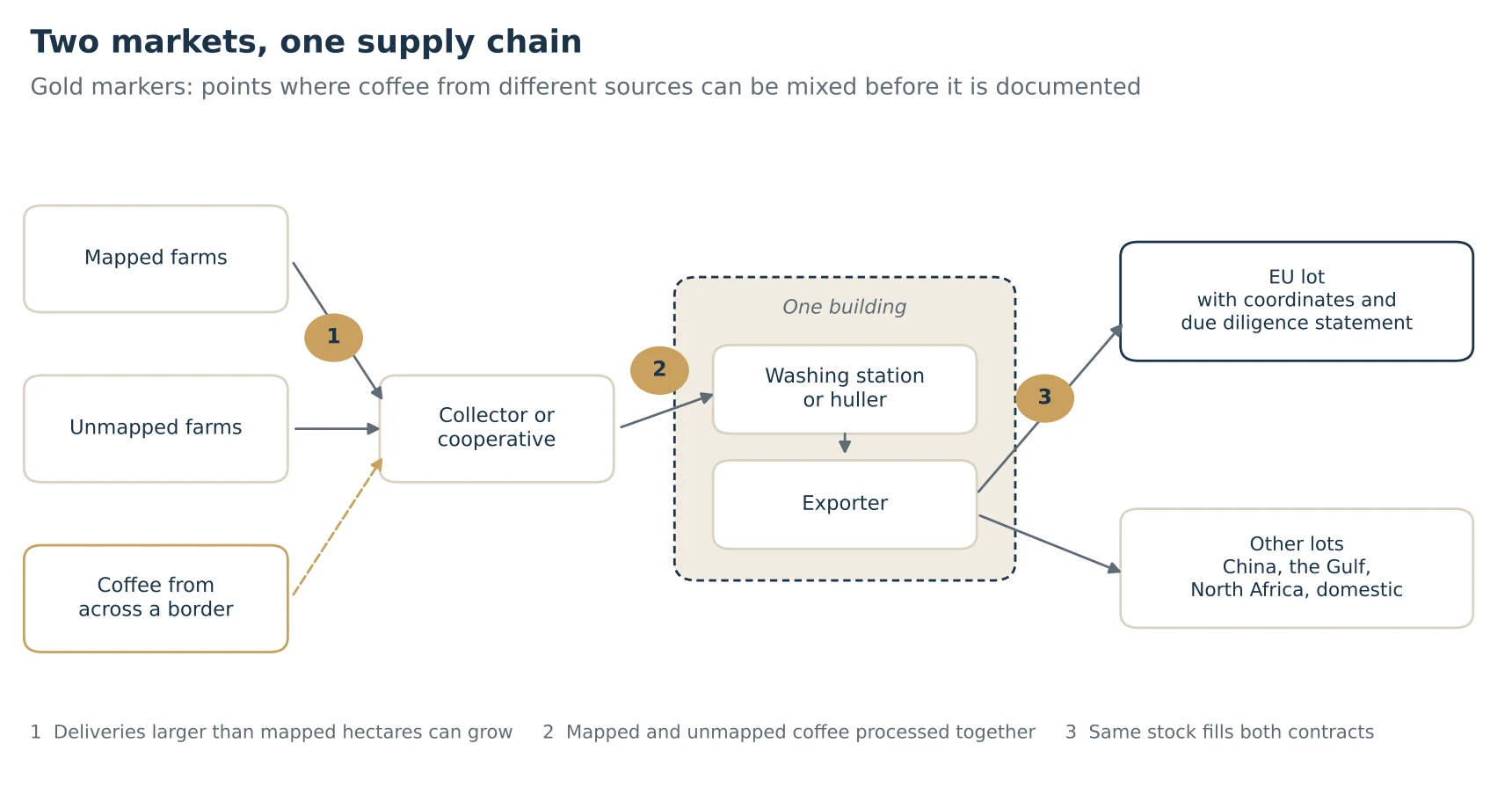
What makes the split risky is that it is not a physical split. The same collector buys cherry from mapped and unmapped farms. The same washing station or huller processes both. The same exporter fills contracts for Hamburg and for Shanghai in the same week. Each door has its own paperwork, but the coffee behind the paperwork comes through one building.
Where the streams can mix
Three points carry most of the risk.
The collection point. A mapped farm in a cooperative register can produce only so much. If the cooperative's deliveries to the "EU lot" exceed what its mapped hectares can grow, the extra came from somewhere. It may be a data error, or a neighbouring farm that hasn't been mapped yet. It may also be cherry bought from anywhere, matched to polygons that look clean on satellite imagery.
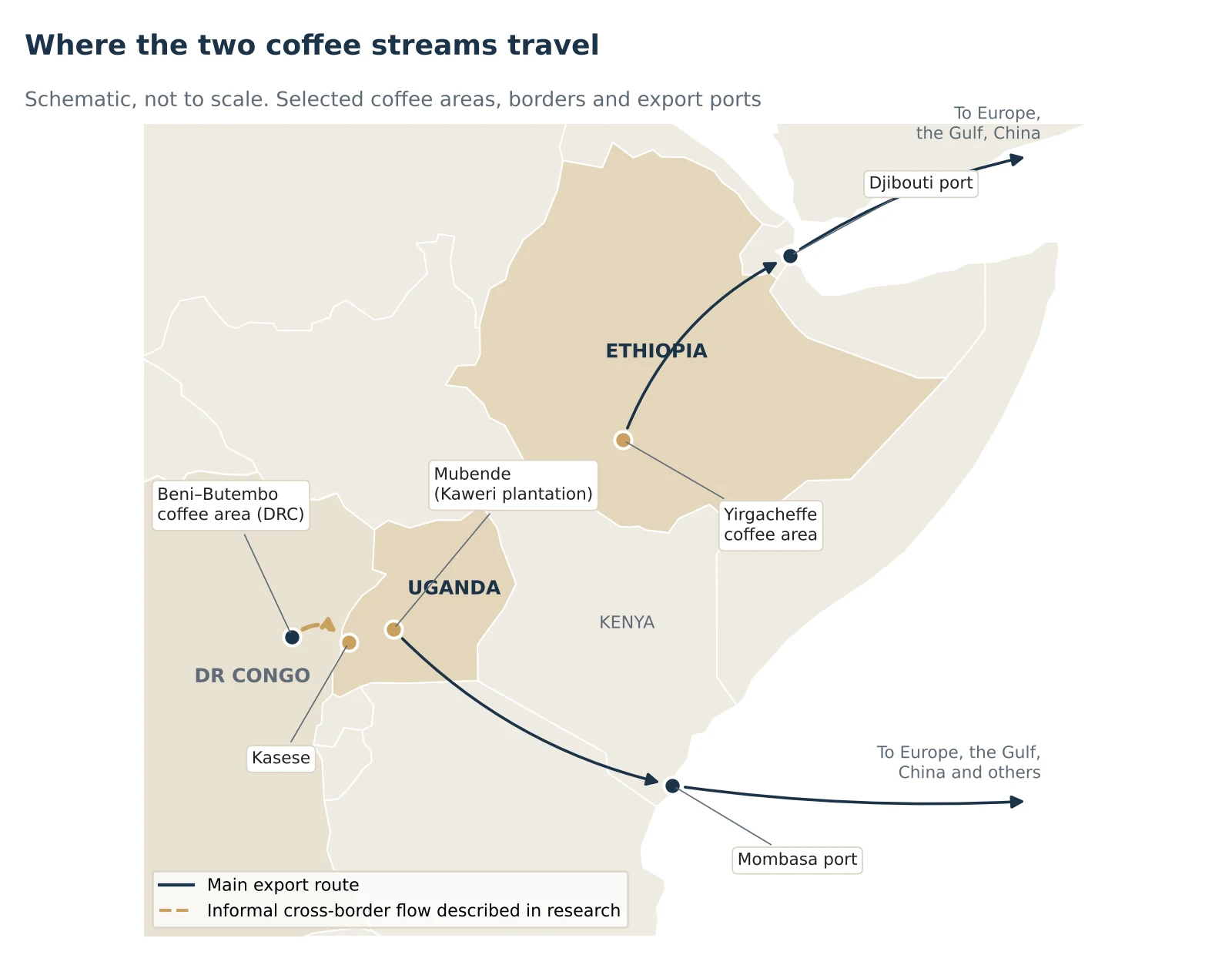
The border. Uganda's western districts sit next to the coffee areas of eastern Congo, around Beni and Butembo, where conflict has disrupted formal trade for years. Research published by the Egmont Institute in June 2025 describes coffee from that area moving into Uganda through both formal and informal channels along the Beni–Kasindi road, and notes that coffee shipments can serve as cover for moving minerals through border posts. Coffee that crosses informally does not arrive with a Congolese label.
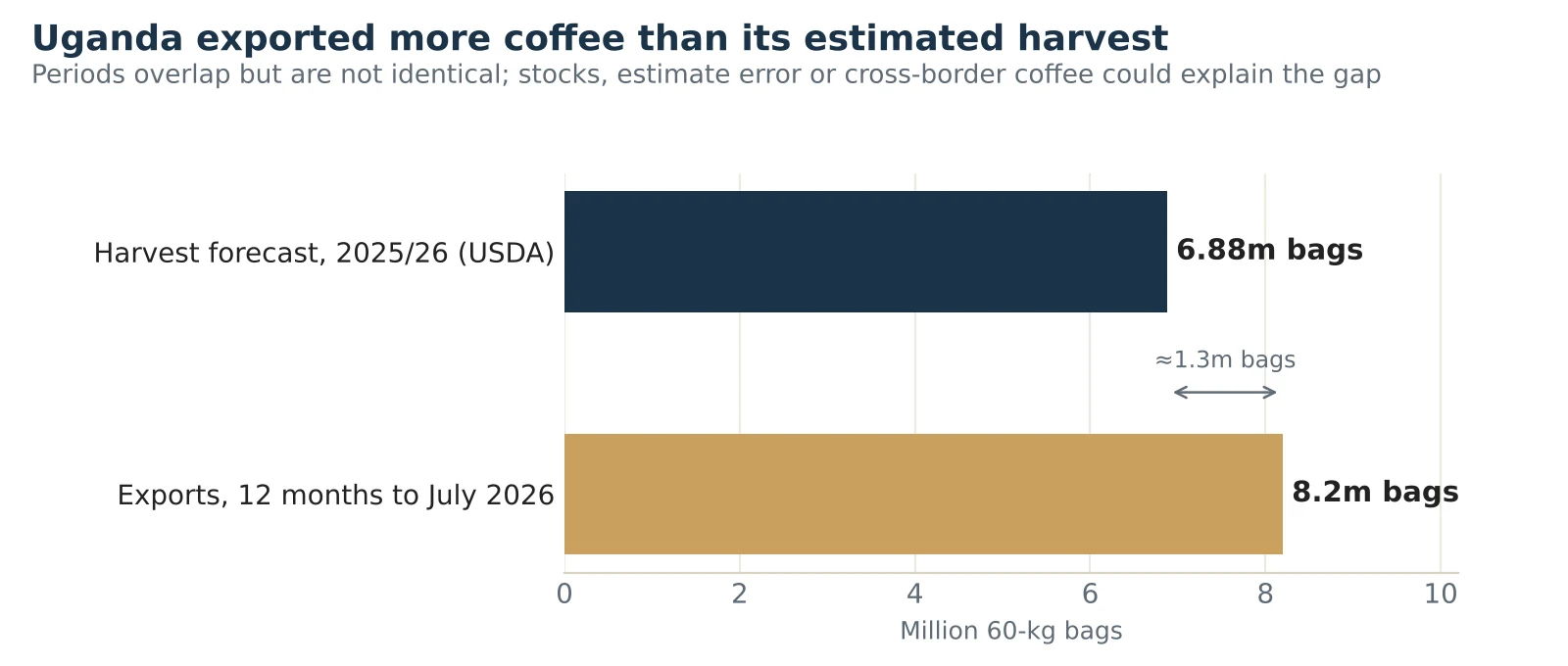
The national numbers. In the twelve months to July 2026, Uganda exported 8.2 million 60-kilogram bags worth $2.13 billion. The US Department of Agriculture's forecast for Uganda's 2025/26 harvest, published in May 2025, was 6.88 million bags. The periods are close but not identical, production estimates for Uganda vary widely between sources, and stocks carried over from a previous season can lift exports above a single year's harvest. Coffee crossing from neighbouring countries is another possible explanation. The figures alone cannot separate these, and they don't prove any of them.
The risks nobody maps
Deforestation is the risk the regulation measures. It is not the only one a buyer carries, and several of the others are easier to miss.
Land. The regulation also requires coffee to be produced in line with local law, including land rights. In 2001, more than 2,000 people were evicted from four villages in Mubende, Uganda, to make way for the Kaweri coffee plantation, a subsidiary of Germany's Neumann Kaffee Gruppe. In 2013 Uganda's High Court declared the eviction unlawful and awarded compensation of 37 billion shillings. The government and the investor appealed. Some families accepted a mediated settlement in 2019, others refused and asked for their land back, and the case was back before the High Court in August 2025. Neumann Kaffee Gruppe has declined to comment further and has distanced itself from responsibility for the evictions. The case has now run for a quarter of a century, and every buyer of Mubende coffee inherits the question.
Counterparties. In 2023 Ethiopia's coffee regulator suspended the export certificates of 58 exporters after finding that bank loans meant for coffee exports had not been used to export coffee. The regulator said it did not know where 49 of the exporters were. A year later, suppliers in southern Ethiopia complained that exporters were buying their coffee on credit and not paying. By then about 90% of Ethiopia's exports went through "vertical integration", direct deals between producers, suppliers and exporters, up from 7% three years earlier. Direct deals make origin easier to trace in principle. They also concentrate the trade in exporters whose finances a foreign buyer rarely sees.
Price. Average coffee prices in Uganda fell from a peak of about $6 a kilogram in mid-2024 to about $3.30 by August 2026, during a drought, and local reporting describes a rise in coffee theft. When prices fall that fast, side-selling, early picking and theft all increase, and each one breaks the link between a mapped farm and the coffee leaving it.
Consider a hypothetical case. A roaster in the Gulf signs a three-year supply contract with an Ethiopian exporter that also sells to Germany. The exporter's EU lots are mapped and audited. Its other lots, which make up most of what the roaster buys, are not. The roaster's buyers start asking where the coffee comes from, the way European buyers began asking five years ago. The roaster finds it has been sold the half of the harvest that nobody checked.
What a buyer should check
For importers, roasters, traders and the banks that pre-finance exporters, in Europe or outside it:
- Check volume against hectares. For each supplying cooperative or washing station, compare deliveries with what its mapped area can plausibly produce. Unexplained surplus is the first question to ask.
- Ask how the streams are separated. Find out whether mapped and unmapped coffee are processed, stored and bagged separately, and how that separation is recorded. Visit, or have someone visit, during the harvest, not after it.
- Look at the exporter, not just the lot. Ownership, licence history, debts to suppliers, bank relationships and any regulatory action. An exporter that cannot pay its suppliers will find ways to fill contracts.
- Map border exposure. Washing stations and hullers in districts next to a border with a conflict area need their own risk rating and their own sampling.
- Test the legality claim. Land disputes, evictions and customary rights claims around the supplying area, including old cases that are still in court.
None of this is cheap at smallholder scale, and nobody can check every farm. A buyer sourcing from thousands of plots will rely, for most of its volume, on samples and on the honesty of the supplier's records. The aim is to test whether those records match what is happening, at the points where they are most likely not to.
What the harvest looks like up close
Most of these questions are answered in the coffee areas during the season. Whether a washing station near Yirgacheffe is buying cherry from outside its registered farmers. What a huller in Kasese pays compared with buyers across the border. Which exporters have stopped paying their suppliers, and which collectors have started appearing with more coffee than their area should produce. This information moves through phone calls, market days and local radio long before it appears in any statistic.
People who work in those markets can compare a cooperative's register with the farms that actually deliver, notice when trucks arrive from the wrong direction, and know which land disputes are live. That doesn't replace mapping or audits. It shows whether the map describes the harvest.
Europe will receive the coffee that can prove its origin. The rest of the harvest is still being sold, to buyers who will one day be asked the same question.
Position as at October 2026. Allegations, court findings and regulatory actions are described as reported. This article does not constitute legal advice.